Perfect Your Pizza!

Our simple tips about pizza making tools, pizza crusts and ingredient measurement will help you create pizza just the way you like it. You can also check out the Frequently Asked Questions section to find more pizza making tips.

Let's Talk Crust
Make and Store your Dough
Tools of the Trade
Measuring Success

Let’s Talk Crust

Basic regular, thin or deep dish, there’s a fan for every kind of crust. You can make the dough for your crust ahead of time, too. Experiment and see what kind of crust you prefer. You can find pizza crust ideas in our crust recipe section.

Basic Regular

There are literally thousands of available pizza crust recipes, but most use four essential ingredients: yeast, water, salt and flour. To increase a crust’s tenderness and flavor, add sugar and oil.

Thin

For a thin crust, start with half the dough that you would use for a basic regular crust. Roll or press it to the same size as the basic regular crust recipe.

If you want a crispy pizza crust, go easy on the toppings. The more sauce and toppings, the less crispy the crust will be.

If using a pan, remove pizza from it as soon as you take it out of the oven and place it on a cutting board because leaving pizza on the pan traps steam and softens the crust.

Let the pizza cool for a few minutes before slicing. This will set the cheese.

Deep Dish

Using a pan with deep sides is important for baking deep dish pizza. If you don’t have a deep dish pizza pan, try a round cake pan or a springform pan.

Usually, you’ll need to pre-bake the crust so it will not be soggy. Follow the recipe’s directions.

For a crisper deep dish crust, layer cheese on top of the crust and then add sauce. Finish with other toppings and more cheese.

Back to Top

Make and Store your Dough

Refrigerated Dough

Pizza dough can be refrigerated up to 24 hours. Here are two ways to store it:

  1. Place kneaded dough in a greased bowl and cover with plastic wrap. Refrigerate. Remove dough from refrigerator 1 hour before shaping the crust.
  2. Roll or shape the kneaded dough on a well-floured counter. Place on cornmeal or flour-dusted baking sheet or pizza pan. Cover with plastic wrap that has been sprayed with cooking oil. Refrigerate. Remove dough from refrigerator, top and bake as usual.
Pre-baked Crust
  1. Roll or pat dough into pizza pan or place on baking sheet.
  2. Bake at 425°F until dough is just starting to brown and appears to have set.
  3. Remove crust from pan and cool on a rack.
  4. When completely cool, place crust in a large re-sealable plastic bag. Freeze for up to 2 months.
  5. Remove from freezer, top and bake as usual.

Back to Top

Tools of the Trade

Oven

A hot oven is essential for a crispy pizza crust and fully cooked toppings. Pizza ovens at your local pizza shop can reach 700 to 800°F, which helps produce crispy crusts.

Our recipes generally recommend baking pizza on the lowest oven rack at 425°F. If you want to bake at your oven’s highest temperature, decrease baking time and closely watch the crust to see if done.

Stones

To make the crispest crusts at home, use a stone for baking pizzas.

Preheat the pizza stone on a lower oven rack for at least 30 minutes prior to baking.

Place pizza crust on a well-floured or cornmeal-dusted pizza peel, flat baking sheet or back of a baking sheet. Parchment paper (not waxed paper) works, too. Make sure that the crust moves freely.

Add your toppings to the crust.

To bake, slide the pizza off the pizza peel or baking sheet onto the preheated stone that is still in the oven. Use a long-handled spatula to help transfer the pizza if needed.

When the pizza is done, remove it from the oven with a pizza peel. You can also use a spatula or tongs to gently transfer the pizza to a cutting board, pizza pan or cookie sheet for serving.

Allow the oven to cool before removing the pizza stone and follow the manufacturer’s directions for cleaning it.

Some pizza stones can be used for grilling. Follow manufacturer’s recommendations.

Visit Easy Steps in the Recipe Video section for a visual presentation.

Grills

Find your favorite grilled pizza recipe and prepare your crust and toppings. Try these tips for grilled pizza success:

Shape a smaller crust that is no larger than an 8-inch circle. Bigger pizzas are hard to handle, and the toppings won’t cook through before the crust burns.

Place the crust on a well-floured or cornmeal-dusted baking tray.

Brush both sides of the crust with oil.

Preheat the grill to a moderately hot temperature, about 400°F.

Carefully place pizza dough on the grill with your hands. Close the lid and cook for 3 to 4 minutes or until the bottom is lightly browned and the top looks “set.” Crusts will be irregular sizes – not perfect circles.

Use long-handled tongs to remove the crust from the grill. With grilled side facing up, place the crust on a platter or baking sheet.

Lightly top the grilled side of the crust. Too much sauce or too many toppings make the pizza hard to handle. Also, the toppings may not finish cooking before the crust burns.

Slide pizza onto the grill. Cook an additional 3 to 4 minutes or until cheese begins to melt and the crust’s bottom has browned. There should be a flavorful char or grill marks on the crust.

Visit Pizza Favorites in the Recipe Video section for a visual presentation.

Pans

Pizza pans come in all shapes and sizes. For a slightly crispier crust, use a perforated pan. Many of our recipes are made using a 12-inch pan. However, a special pan isn’t essential for baking pizza. You can also try using the following:

  • Cookie or baking sheet (flat or with sides)
  • Back of a baking sheet
  • Baking dish

Before placing the pizza on the pan, grease the pan with olive oil, Mazola Corn Oil or Mazola Vegetable Plus! Oil or spray generously with cooking spray. Like the pizzerias, generously sprinkle the bottom of the crust with cornmeal.

Visit Easy Steps in the Recipe Video section for a visual presentation.

Thermometer

When making your crust with Pizza Crust Yeast, use very warm or hot tap water (120° to 130°F). You can use any kind of thermometer you have – candy, meat, etc.

Measuring Spoons and Cups

Never “eyeball” the amount of ingredients needed for a recipe. Use measuring spoons and cups for accuracy. See “Measuring Success” for the correct way to use measuring spoons and cups.

Wooden or Metal Spoon

It is best to use a long handle spoon, either wood or metal will do.

Rubber Spatula or Plastic Bowl Scraper

These flexible tools can be used for scraping down dough from the side of the bowl, dividing dough and transferring dough.

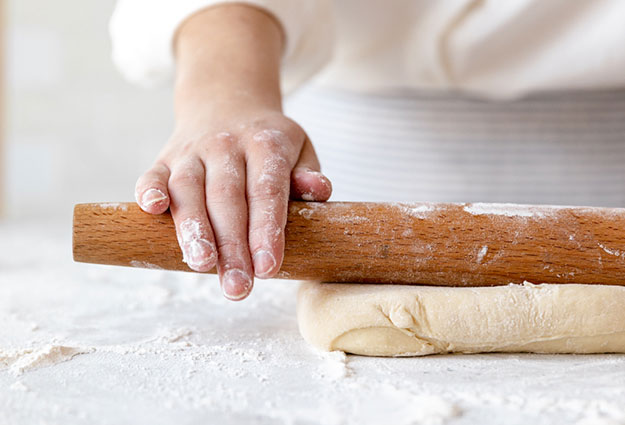
Rolling Pin

This tool is helpful for shaping and rolling dough. You can always use your hands, too.

Pizza Peel (Nice to have, but optional)

This flat long-handled tool is used to slide pizzas onto a baking stone. A flat baking sheet or the back of a baking sheet will work if you don’t have a pizza peel.

Visit Easy Steps in the Recipe Video section for a visual presentation.

Ruler (Nice to have, but optional)

Use a ruler to measure dough after it’s been rolled to be sure it fits your pan or space.

Back to Top

Measuring Success

All of our recipes are double tested and use uniform standards for measuring ingredients. Here’s how we measure:

  • Flour - Gently spoon into a measuring cup. Level off with a knife or straight edge. Do NOT dip the measuring cup into the flour canister or bag. This may result in adding too much flour, which makes the crust dry and flavorless. Visit Easy Steps in the Recipe Video section for a visual presentation.
  • Liquids – Use clear, liquid measuring cups designed to easily read amounts. Always place the cup on a level surface to read.
  • Measuring Spoons – Level off with a knife or a straight edge.

Back to Top